Biomethane road map for Ukraine: action plan through 2050
We are sharing the second important analytical document prepared as part of the Innovate Ukraine project: “Development of a Business Model for Biomethane Production in Ukraine”.
This Road Map outlines Ukraine’s long-term strategic pathway for the sustainable development of the biogas and biomethane sector through 2050. It establishes a clear vision, milestones and enabling conditions required to mobilise Ukraine’s organic resource base and integrate its renewable gas production into both domestic energy systems and European markets.
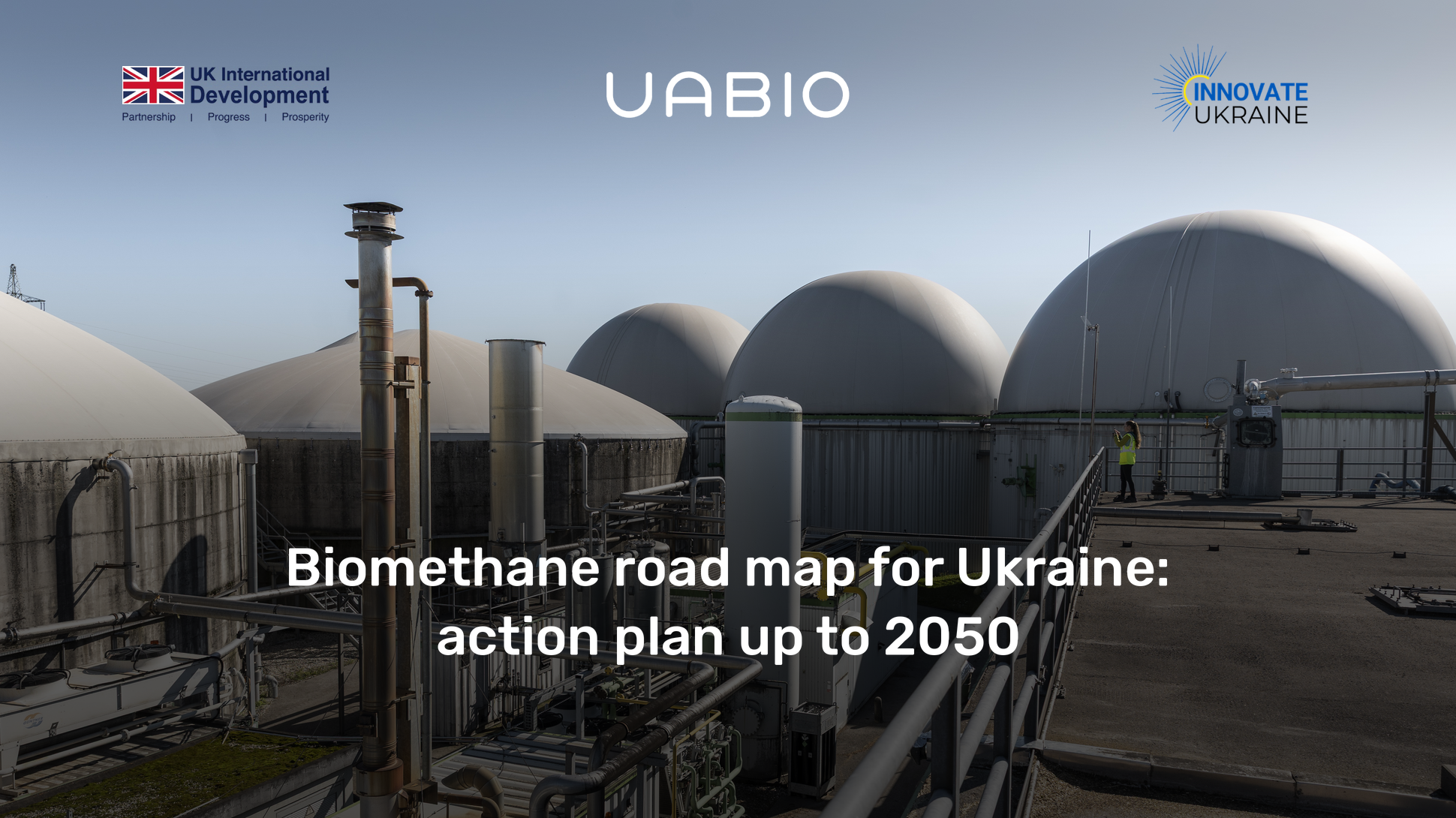
The Road Map to 2050 defines a phased integration of Ukraine into the European renewable energy and renewable gas markets, in which biomethane, synthetic gases and other renewable gases become core export and system-forming energy carriers.
During the period 2025–2026, Ukraine establishes the legal and institutional foundations for full market entry of Ukrainian biomethane into the European Union, including the alignment of regulatory frameworks, connection rules, certification systems and trading procedures. In the medium term, this enables rapid scaling of production, investment mobilisation and deep integration into European energy and climate markets.
In the long-term horizon to 2050, this trajectory supports the emergence of an export-oriented renewable gas economy, underpinning Ukraine’s energy security, decarbonisation pathway and post-war economic recovery.
Download the Biomethane road map for Ukraine (in English)
Key topics of the roadmap:
- market and policy baseline;
- infrastructure and market integration;
- export and domestic market regulatory barriers for biomethane;
- short-term, medium-term, and long-term development of the Ukrainian biogas/biomethane sector;
- governance, monitoring and strategic oversight.
The report also includes a detailed Action Plan for Improving the Legal and Regulatory Framework for Biomethane Development (Annex I at the end of the document).
Ukraine’s potential
Ukraine possesses one of the largest technical potentials for biomethane production in Europe, according to the recent studies of UABIO 21.8 billion cubic meters per year from a diverse range of feedstocks.
The structure of Ukraine’s biomethane potential is particularly favourable for EU market integration. Almost 45% of the national biomethane potential is derived from cover and sequential crops, which do not compete with food production and significantly improve soil quality through crop rotation and digestate return. A further 24% originates from crop residues, and only 17% from maize silage if cultivated on approximately one million hectares.
By contrast, livestock manure and poultry litter contribute only about 4% of the national potential, reflecting the long-term decline in animal numbers in Ukraine since 1990. The remainder is provided by food-processing residues (about 3.6%), municipal organic waste and wastewater sludge (about 2.5%), and solid biomass gasification (about 4%).
This structure means that more than 80% of Ukraine’s biomethane potential comes from agricultural residues, cover crops and by-products, fully compatible with Annex IX of RED II and RED III, making Ukraine structurally well positioned to supply advanced, sustainability-compliant biomethane to the EU.
Expected Results by 2050
- Ukraine produces 20 bcm of biomethane per year.
- Ukraine is a strategic renewable gas partner of the EU.
- Biomethane is a major domestic energy source replacing fossil imports.
- Ukrainian exports gain a structural CBAM advantage through low-carbon energy.
- Agriculture, energy and industry operate as a single circular bio-energy system.