Practical aspects of CBAM monitoring and reporting. Step-by-step instructions for exporters
A key online event titled “Practical Aspects of CBAM Monitoring and Reporting. Step-by-step Instructions for Exporters” was held on December 12, 2025, just before the conclusion of the Carbon Border Adjustment Mechanism (CBAM) transitional period.
Given that the CBAM reporting transitional period ends on December 31, 2025, the webinar’s topic was critically relevant. It is crucial for Ukrainian manufacturers producing CBAM goods for export to the EU to not only finalise the reporting accurately but also to prepare the internal methodological framework for the mechanism’s full operation.
Event materials (in Ukrainian)
Download Vyacheslav Panov’s presentation
Download Volodymyr Kramar’s presentation
Download Semen Drahniev’s presentation
Course of events
The event was opened by Georgii Geletukha, Chairman of the Board of the Bioenergy Association of Ukraine (UABIO). He stressed that effective interaction with European importers and the preparation of verified emissions information is not just a regulatory requirement, but a strategic condition for maintaining the competitiveness of Ukrainian goods in the EU market.

The participants received comprehensive information divided into three key blocks: internal documentation development, practical calculations, and coordination with European partners.
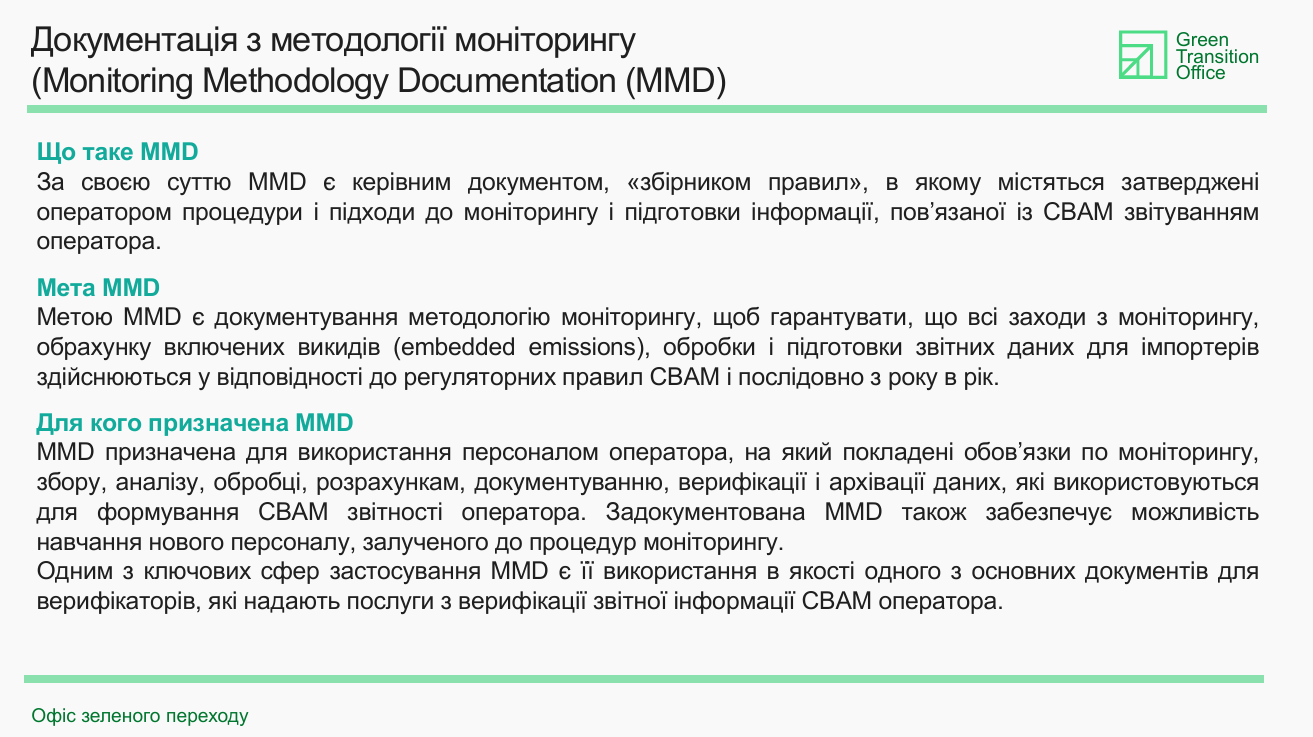
The first speaker was Vyacheslav Panov, Decarbonization Expert at the Green Transition Office. His presentation, “Development of MMD CBAM Documentation: The basis for Successful Monitoring and Reporting”, revealed the key role of the internal Monitoring Methodology Documentation (MMD) for the manufacturer-exporter, who is the operator of the production installation.

The speaker conceptualised the MMD not as a static report but as a dynamic management tool (“rulebook”).
From a methodological perspective, the MMD standardises the operator’s internal procedures. Its goal is to minimise data uncertainty by documenting the algorithms for collecting, processing, and consolidating emissions information. The document serves as a guarantee of consistency and reproducibility of monitoring results year-on-year, which is critical for passing future verifier audits.
Audience and Requirements
The MMD is intended for the operator’s personnel responsible for collecting, analysing, processing, calculating, and archiving the data used for CBAM reporting. Furthermore, the documented MMD is one of the essential documents for verifiers.
Mr Panov presented a suggested structure for the MMD that ensures full coverage of CBAM requirements:
- Purpose and Scope: Description of the MMD’s role, CBAM coverage scope (sectors, CN codes), regulatory framework, and updating rules.
- Operator and Installation Data: Information about the company, the installation, and contact details of responsible persons.
- Installation Description: Detailed description of production, products, technology, and CN codes.
- System Boundaries and Process Description: Definition of installation boundaries according to CBAM rules, description of production processes, routes, input/output materials, and energy resources.
- Parameters to be Monitored: Description of approaches to monitoring direct and indirect emissions at the installation and production process levels, and the methodology for determining embedded emissions.
- Written Procedures, Management, and Control: Description of written procedures for laboratory analysis, inventory of measuring instruments, data processing, and risk control.
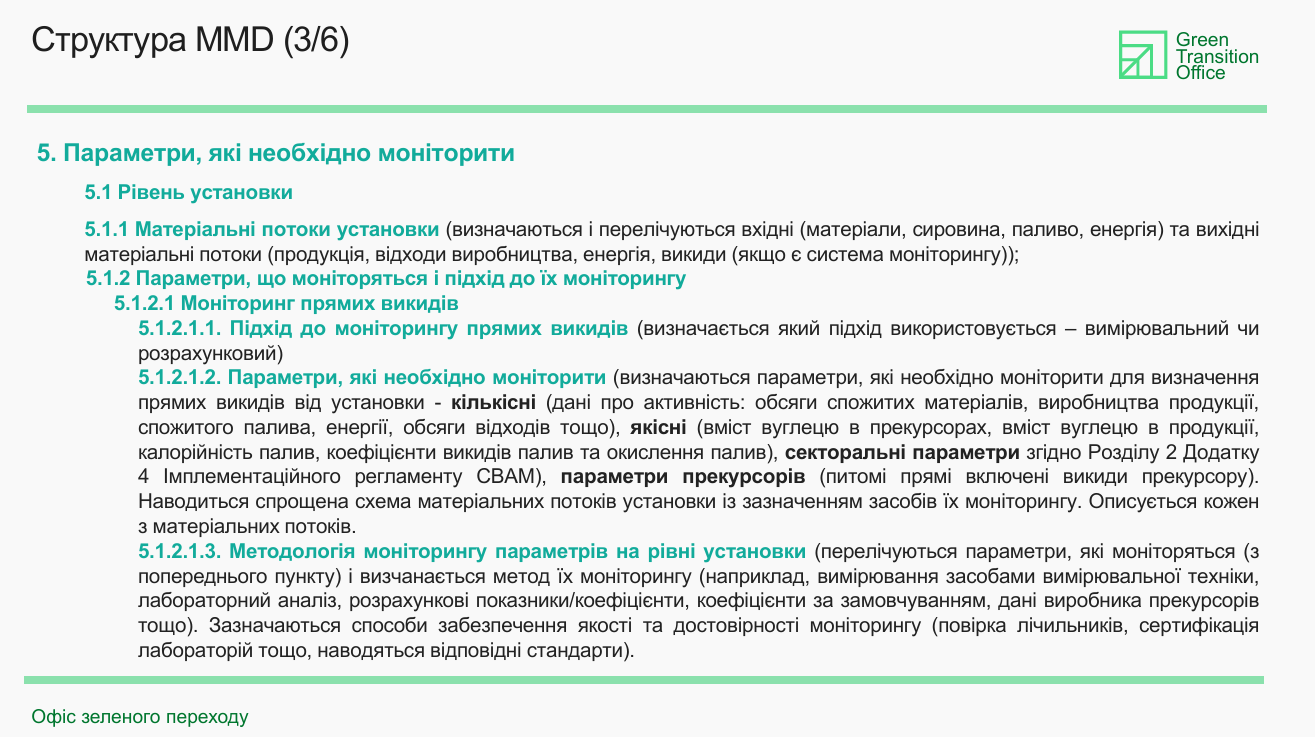
The presentation demonstrated that the MMD is not a bureaucratic requirement but a complex engineering and economic model of the enterprise. Its development requires a synergy of knowledge from technologists, environmental specialists, and metrologists. This scientifically grounded approach is the only way for Ukrainian exporters to successfully pass verification and integrate into the European market under CBAM.
Volodymyr Kramar, Director of Biomass-Carbon LLC, presented “Emission Monitoring and Calculation: Practical Aspects of Applying the CBAM Methodology “. He focused on the technical aspects of collecting activity data (volumes of consumed materials, fuel, energy) and calculating direct and indirect emissions.
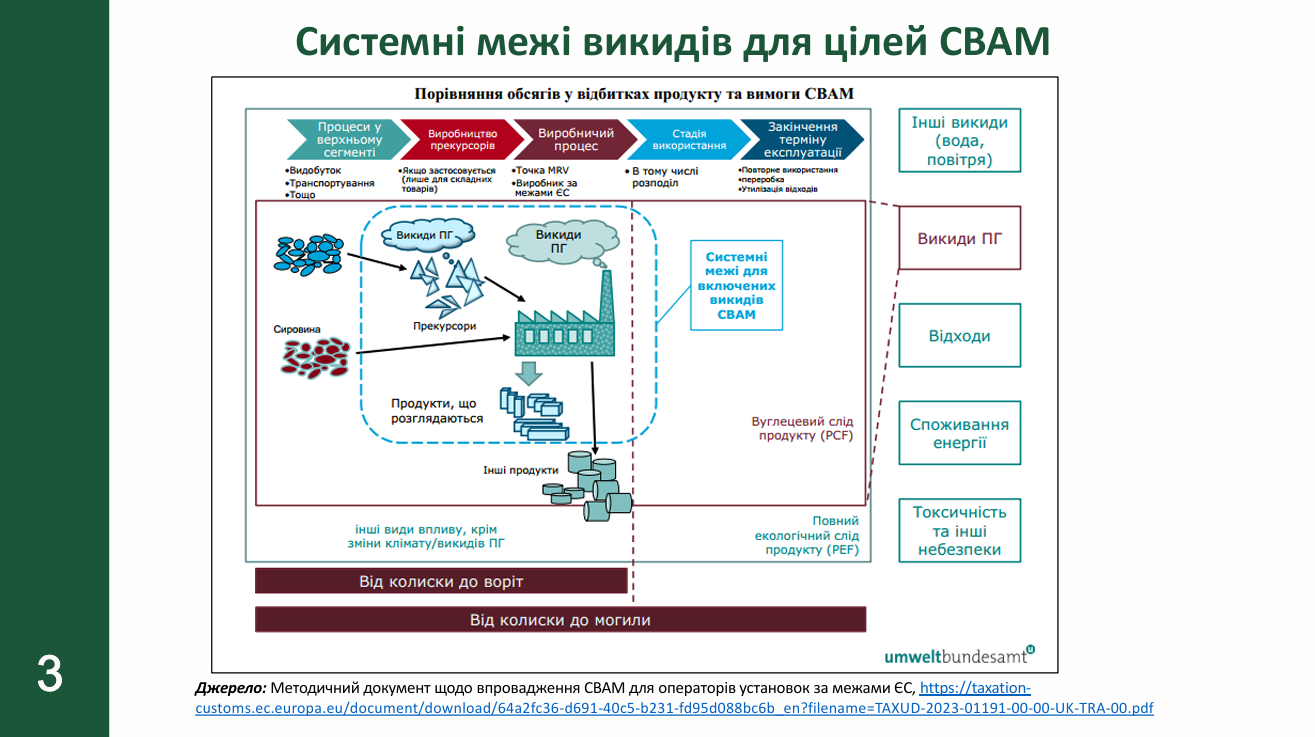
The strict definition of system boundaries is the foundation for the correct calculation of embedded emissions. Mr Kramar emphasised that the CBAM methodology is based on a “Cradle-to-Gate” approach. Monitoring covers production processes related to the extraction and processing of precursors, as well as the direct manufacturing process at the installation, but excludes raw material transportation (cross-border), product use by the consumer, and waste disposal after the end of life.
The expert detailed three main approaches exporters can use to determine emissions: the calculation-based approach, the measurement-based approach, and other methods that may be accepted if they comply with existing mandatory monitoring schemes outside the EU and ensure similar accuracy to CBAM.
CBAM and Sustainable Biomass
It was noted that CBAM sets a “zero rate” for СО2 emissions from biomass when used as fuel or a technological material.
However, this rule applies provided that:
- Biomass used as fuel (“for energy purposes”) meets the sustainability and greenhouse gas emission reduction criteria of the RED II Directive.
- From May 21, 2025, the requirements for proving the sustainability of biofuels also extend to installations that started using biomass before January 1, 2021.
A practical example of iron ore pellet production was reviewed. The diagram clearly demonstrated the exclusion of ore extraction processes from the installation boundaries. The monitoring system boundaries included the processes of: batch preparation (drying, crushing); sintering/firing; gas purification. In this case, the mass balance method was identified as optimal for emission calculation, accounting for carbon from fuel (coke, natural gas) and technological raw materials (limestone, carbonates).
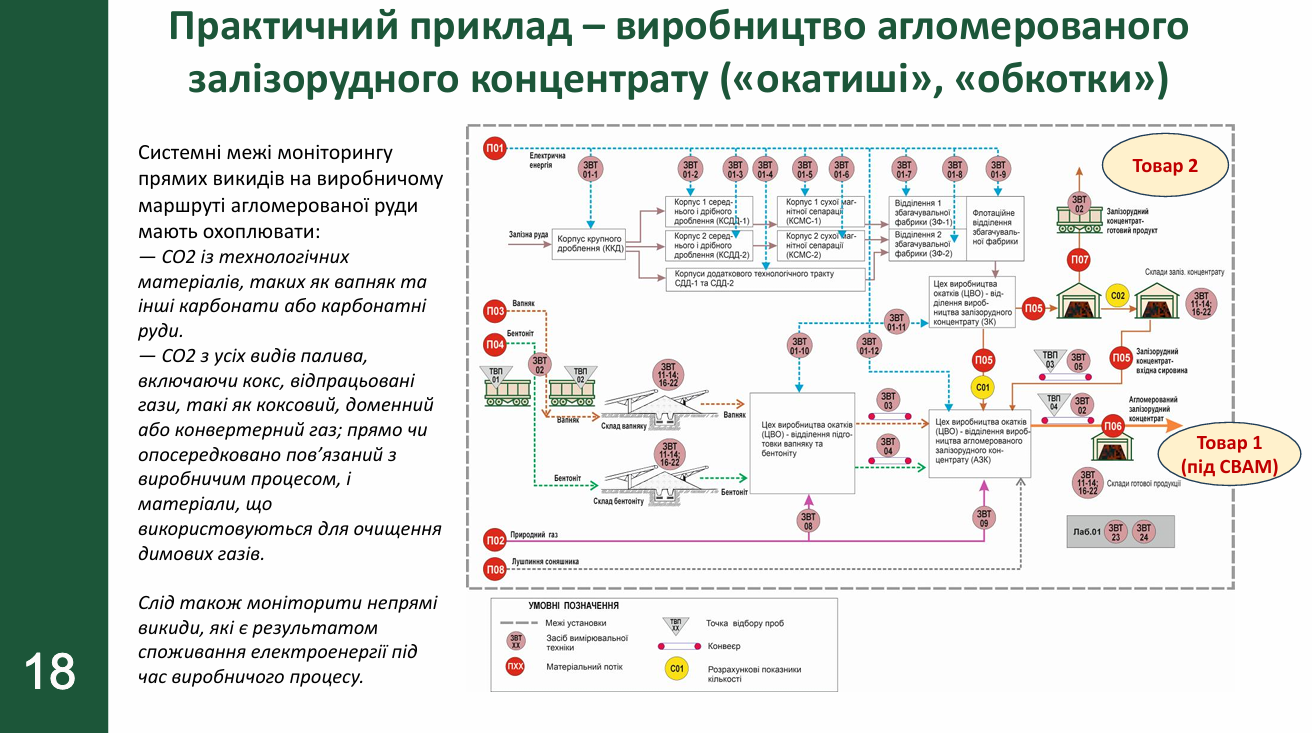
The report convincingly proved that CBAM implementation requires Ukrainian manufacturers to shift from formal environmental reporting to high-precision carbon engineering calculation. The key takeaway is that the economic efficiency of exports will directly depend on methodological literacy: selecting the relevant monitoring method (standard or mass balance), correctly defining boundaries, and documentary confirmation of biomass sustainability. These are the only legitimate tools to avoid the use of default values and, consequently, prevent high financial costs for CBAM certificates.
The final block, critically important for the smooth export of CBAM goods, was presented by Semen Drahniev, Expert at Biomass-Carbon LLC, on the topic: “Cooperation with the EU importers: Data Transfer and Coordination of the Verification Process”. This aspect is vital because successful CBAM reporting depends not only on the quality of the exporter’s data but also on the efficiency of its transfer and processing by the importer.

The presentation shifted the focus from internal plant processes to the plane of international communication, detailing the mechanisms by which engineering data transforms into CBAM certificates, which determine the importer’s financial obligations.

Key Highlights:
- Establishing Communication: It was emphasised that Ukrainian exporters must establish a clear and constant channel of communication with their EU importers. The importer is the final declarant and is responsible for submitting CBAM reports using the information provided by the manufacturer.
- Standardised Data Transfer (CBAM Communication Template): Semen Drahniev explained in detail how to use the CBAM Communication Template – a format recommended by the European Commission for the structured transfer of information on direct and indirect emissions, and the methodology for their calculation. This minimises errors and accelerates the process of including data in the report.
- Verification Coordination (from 2026): Starting when CBAM becomes fully effective (from January 1, 2026), the data on embedded emissions must be subject to verification by accredited verifiers. The exporter must coordinate their internal procedures (MMD, monitoring) with the requirements of the importer’s verifier to ensure timely and successful certification. The absence of verified data will force the importer to use default values, which can significantly increase the financial burden on the imported goods.
- Timing and Responsibility: The expert stressed the need for strict adherence to deadlines for submitting data to the importer, allowing them to prepare their quarterly reports during the transitional period, and subsequently, their annual declaration.
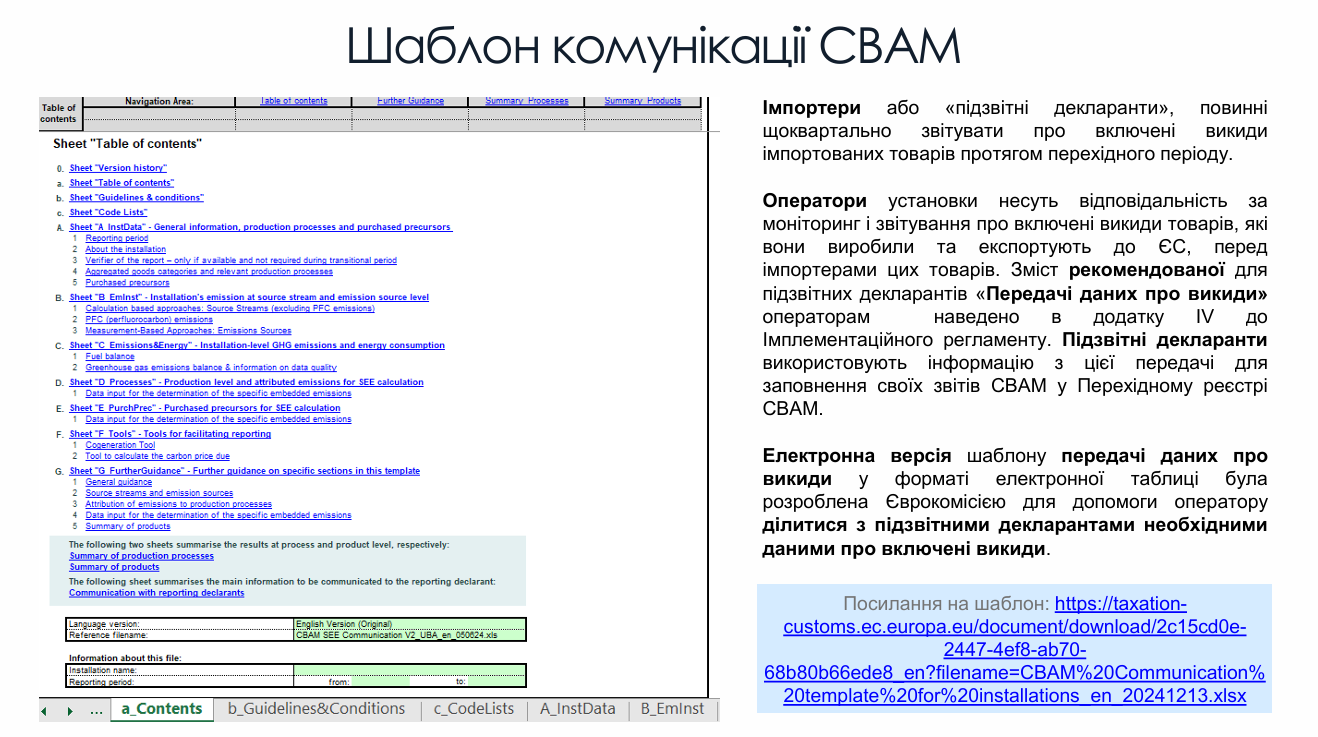
The quality and timeliness of communication now transcend a commercial agreement and become a critical requirement that directly impacts the cost of CBAM certificates and the financial obligations of EU importers. The manufacturer must transform their internal carbon footprint into a standardised, legally suitable data package, using the recommended CBAM Communication Template or the portal for operators of installations in third countries.
Conclusions
Based on the expert presentations and detailed analysis of practical cases, several strategic priorities can be highlighted for Ukrainian exporting enterprises:
- Documentation as the Foundation: Developing and implementing the internal Monitoring Methodology Documentation (MMD) is not a formality but a mandatory condition. Without clearly documented procedures, the operator risks data verification refusal, leading to penalties and the transition to default emission values.
- Economic Viability of Engineering Precision: Applying empirically established activity data based on actual emission factors and detailed carbon mass balance at the installation level is a strategic imperative. Quality internal monitoring functions as an effective risk management mechanism, allowing for the avoidance of penalties. This technical preventive measure directly minimises the potential financial burden on imported goods, which is key to maintaining the competitiveness of Ukrainian products in the European market.
- Calculation Accuracy Ensures Competitiveness: For progressive enterprises, using actual embedded emission data, based on current emission factors and the carbon mass balance, will be more economically beneficial than using EU default values. Experts emphasised that quality monitoring can significantly reduce the potential financial burden at the border.
- Synchronisation with EU Partners: Effective data transfer via the CBAM Communication Template, the O3CI CBAM portal, and coordination with European importers must become part of business practice. The success of Ukrainian exports now directly depends on the transparency and speed of environmental information exchange.
- Sustainability and Bioenergy: For industrial enterprises using bioenergy technologies for decarbonization, confirming compliance with RED II sustainability criteria remains critically important. Only the use of sustainable biomass allows for claiming a zero-emission rate in the context of CBAM.
The event featured high participant activity, including leading Ukrainian producers of CBAM goods, scientists, educators, and other interested parties. Organisers also invited manufacturers and exporters to take advantage of the support initiative, which offers express consultations on CBAM from Biomass-Carbon LLC within the framework of the PKB24UA03 project
Thus, in the context of strengthening European integration processes and strategic orientation towards the EU market, the ability of Ukrainian exporters to quickly and correctly adapt to CBAM requirements is a direct indicator of their international competitiveness. The expert presentations not only clarified regulatory norms but also provided specific practical tools – from the MMD template to emission calculation methods and mechanisms for interaction with the importer.
The webinar was organised under the project PKB24UA03 “Technical Assistance for CBAM Goods Export from Ukraine to the EU”, which aims to increase the readiness of the Ukrainian industry for CBAM requirements, which is implemented with the support of the Ministry of Foreign Affairs of the Kingdom of the Netherlands and the Netherlands Enterprise Agency. Funding is provided by the Private Sector Development Program of the Netherlands Enterprise Agency/The Netherlands Enterprise Agency.
The project “Technical Assistance for CBAM good exports from UA to EU” began on November 25, 2024, and will last until February 28, 2026. This project is implemented with the support of the Ministry of Foreign Affairs of the Kingdom of the Netherlands and the Netherlands Enterprise Agency.