Moving from natural gas to biomethane and e-methane: the path to decarbonising maritime transport
For the SAF platform, we have prepared a review of the SEA-LNG report, which analyses the ten-year development of LNG as a marine fuel and its role in the decarbonisation of shipping. The document examines the sequential path to reducing emissions in the industry — from liquefied natural gas (LNG) to liquefied biomethane (Bio-LNG) and e-methane.
The report assesses the current state of the LNG fleet and infrastructure, investment dynamics, regulatory context, and prospects for scaling up renewable and synthetic gases.
The advantages of methane
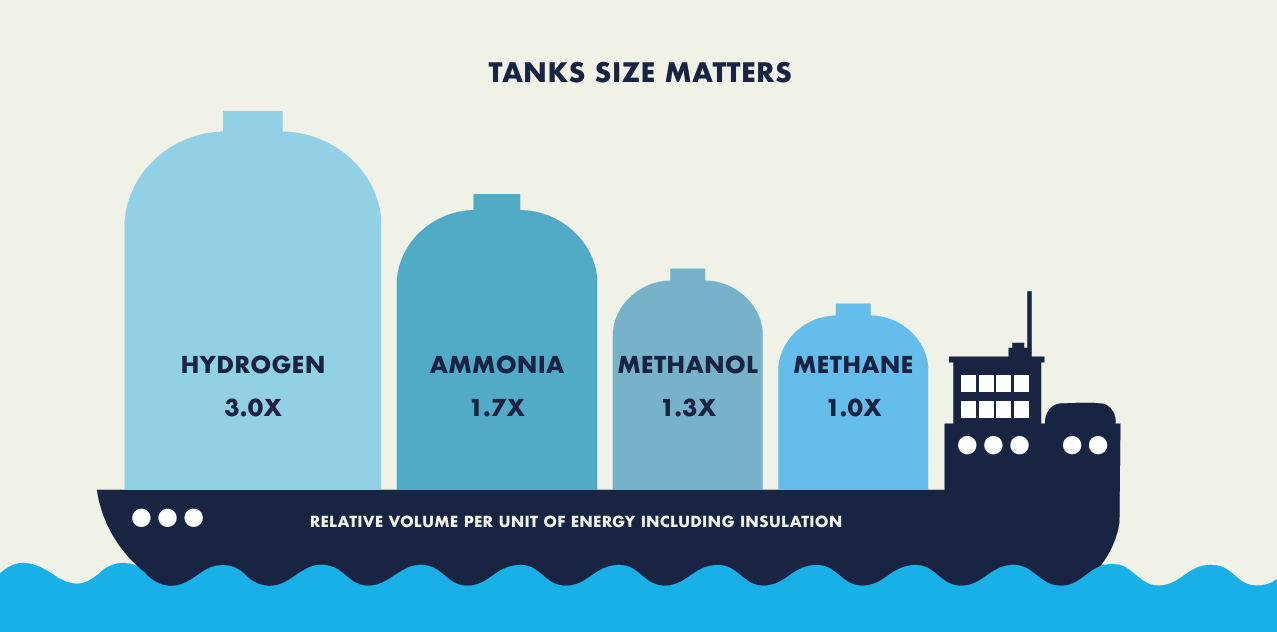
Taking into account the insulation requirements for tanks, methane has the highest energy density among the alternatives. Methanol will require a tank 1.3 times larger, for the same amount of energy and the multiples for liquefied ammonia and hydrogen are 1.7 and 3.0 respectively.
LNG as the first stage of transition
The number of LNG-powered vessels has increased tenfold to 850 vessels in operation and another 642 on order. In total, the LNG fleet (in operation and on order) already exceeds 10% of the global fleet.
LNG bunkers are now available in 222 ports with plans for a further 62. Investment in LNG dual fuel vessels and the associated fuel supply chains over the past 10 years has amounted to more than $150 billion.
The next step in decarbonisation: liquefied biomethane
It is estimated that biomethane production could increase 20-fold by 2050. Once demand from other sectors is taken into account liquefied biomethane has the potential to play a significant role in decarbonizing shipping.
If used in the form of a 20% blend with LNG, it could cover up to 16% of global shipping demand by 2030.
BIO-LNG bunkering in Europe
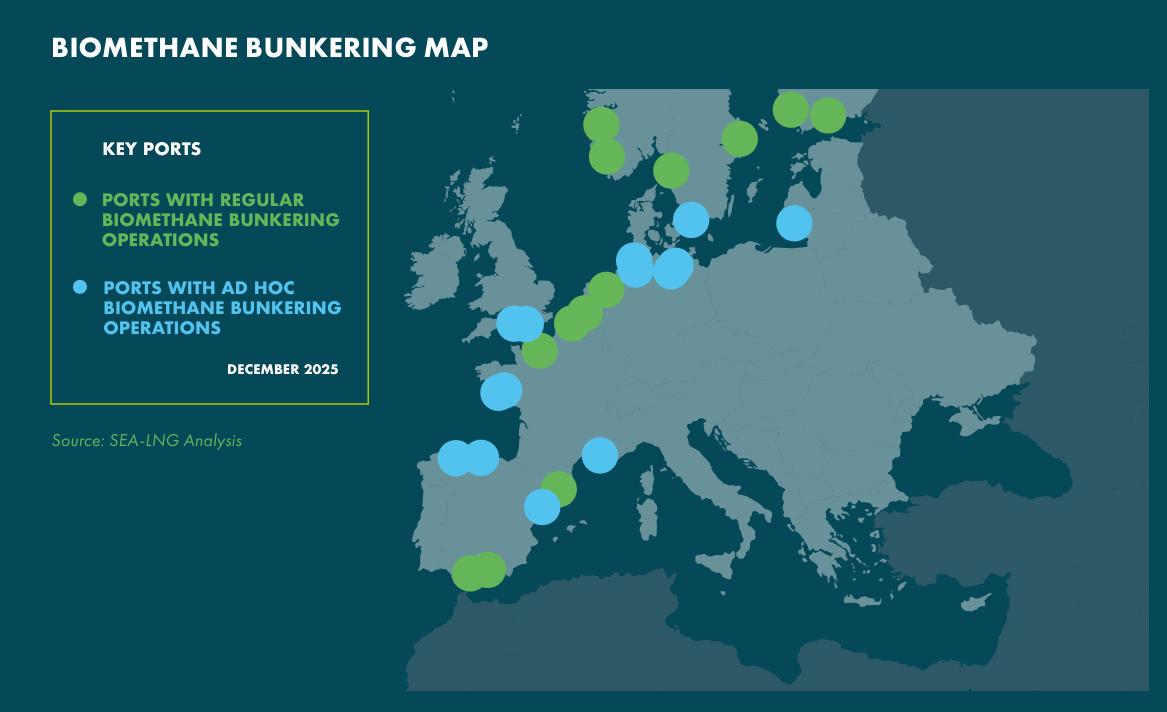
In 2025, Europe is experiencing a boom in Bio-LNG bunkering. Bio-LNG bunkering operations have already been carried out in key ports in Belgium, France, Finland, Italy, Lithuania, the Netherlands, Norway, Spain, Sweden and the United Kingdom, with at least 10 major suppliers involved.
Read the full material with a section on e-methane and more detailed information on liquefied biomethane on the SAF platform. You can also download the full SEA-LNG report there.
We remind you that UABIO is a partner of the Sustainable agribusiness platform (SAF).
SAF is a communication platform that brings together agribusiness stakeholders and aims to establish strong links between market players and introduce sustainable approaches in agriculture. For this platform, our team prepares verified professional content on the bioenergy sector.