Methodological guidelines No. 2 on CBAM: monitoring and calculation of embedded emissions for installation operators
In March 2026, Biomass Carbon LLC publishes its second methodological guidelines on the Carbon Border Adjustment Mechanism: “Technical Guidance on Monitoring and Calculation of Embedded Emissions for Installation Operators”, which pertains to the definitive period of the CBAM, starting January 1, 2026.
The document, prepared within the framework of the project “Technical Assistance for the Export of CBAM Goods from Ukraine to the EU” — implemented with the support of the Ministry of Foreign Affairs of the Kingdom of the Netherlands — is designed to assist Ukrainian exporters in adapting to the CBAM definitive period.
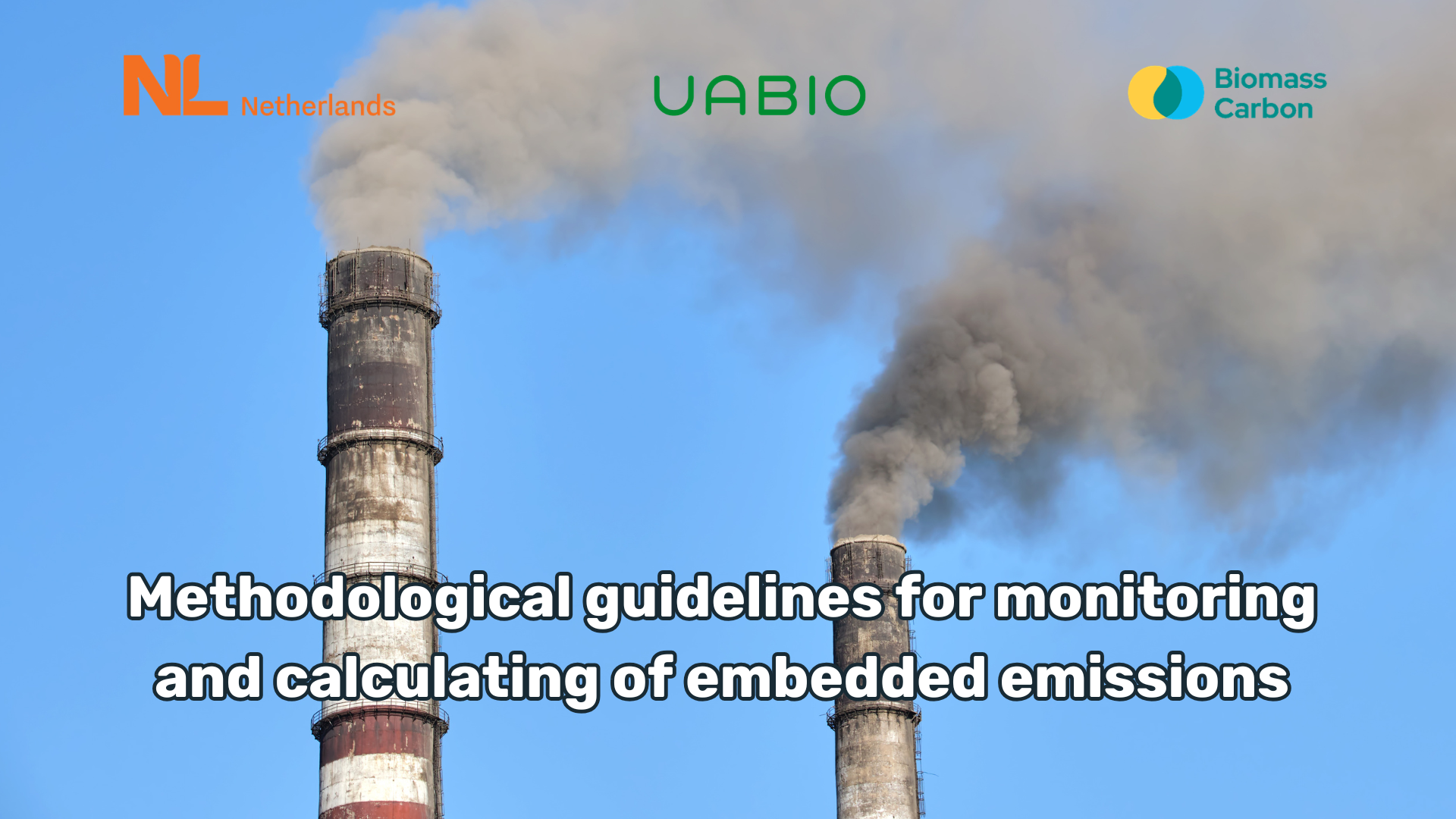
These guidelines are based on the legislative provisions of Regulations (EU) 2023/956 and 2025/2547, with references to other EU legislative acts. The primary focus is placed on the “Iron and Steel” sector; therefore, certain methodological provisions specific to other sectors (such as cement or mineral fertilisers) are not addressed.
Check out the methodological guidelines №2 (in Ukrainian)
About methodological guidelines No. 2
The recommendations cover the full cycle: from the legal framework and classification of goods (pellets, pig iron, DRI, crude steel, ferroalloys, etc.) to the detailed methodology for monitoring direct and indirect emissions, calculation formulas for specific embedded emissions of simple and complex goods, and requirements for measurement systems and laboratory analyses.
Separate sections address the definition of system boundaries, data allocation between production processes, accounting for heat flows, carbon capture and transfer (CO₂ transfer), as well as rules regarding electricity and its emission factors. The document concludes with a section on the verification and reporting system, including sector-specific parameters for the operator’s emissions report, the application of default values, and the adaptation of these values to regional specificities.
Key Stages of CBAM Implementation for Installation Operators and Authorised Declarants
To contextualise these guidelines within the overall CBAM framework, we will briefly outline its main stages and the procedure for fulfilling relevant obligations. An installation operator in a third country (specifically Ukraine) is not the directly liable party to the EU under CBAM; the obligations for declaration and the purchase of certificates rest with the authorised CBAM declarant (the importer or customs representative in the EU).
However, the accuracy and verifiability of the data on embedded emissions depend entirely on the operator. Therefore, the operator bears the practical responsibility to execute the following sequence of actions.
Step No. 1: Checking the product coverage under CBAM requirements
The operator checks the CN (Combined Nomenclature) of the product with Annex I to Regulation (EU) 2023/956. The analogue of CN codes in Ukraine is the UKT ZED code. If the product is complex, it is manufactured using precursors, which themselves are CBAM products and have their own embedded emissions, which are also subject to accounting.
Step No. 2: Defining system boundaries and production processes
Operator:
- Defines the physical boundaries of the installation — all sources of direct CO₂ and N₂O emissions on the production site.
- Divides the installation into production processes (PP) according to the list of goods and functional units (tons of goods produced).
- Establishes a list of precursors — materials purchased outside the PP that carry their own embedded emissions.
- Distinguishes between direct emissions (combustion + process reactions) and indirect emissions.
Step No. 3: Development and implementation of a Monitoring Plan
The operator shall develop a Monitoring Plan (MP). The MP is the primary document that describes the methodology for data collection and calculation, serving as the basis for verification (Article 8 of Regulation (EU) 2023/956). The MP includes:
- Selection of methodology for each source stream: standard calculation-based method (combustion + process), mass balance method, or continuous emission measurement system (CEMS).
- List of measurement equipment, requirements for its calibration, and metrological traceability.
- Methods for determining calculation factors (Net Calorific Value, CO₂ emission factors) and a sampling plan with analysis frequency.
- Rules for data allocation between PPs and between co-products.
- Internal data quality control system (risk assessment, control activities).
Step No. 4: Ongoing monitoring during the reporting year
In accordance with the approved PM, the operator throughout the reporting year (calendar year):
- Measures and records activity data: volumes of fuel, raw materials, semi-finished products, electricity — continuously or in batches.
- Conducts laboratory analysis of design coefficients with a set sampling frequency; applies appropriate default values for standard parameters.
- Keeps records of heat flows during cogeneration or heat transfer/receipt.
- Records embedded emissions of purchased precursors (supplier reports or certificates).
- Records activity levels (quantity of goods produced for each PP).
- Documents any deviations from the MP and corrective actions taken.
Step No. 5: Calculation of specific embedded emissions
Based on the collected data, the operator calculates specific embedded emissions (SEE) (t CO₂e/t of goods), considering the distinction between simple and complex goods. Indirect emissions from electricity are calculated using the default emission factor for electricity, or actual values if supporting evidence is available.
Step No. 6: Preparation of the Operator’s Emissions Report
The operator compiles the Operator’s Emissions Report (OER), which contains:
- Identification data of the installation (name, address, activity, list of produced CBAM goods).
- Description of PPs, system boundaries, and a list of precursors with their SEE.
- Calculation of direct emissions for each PP (combustion + process + CO₂ transfer).
- Calculation of indirect emissions from electricity (except for Annex II goods).
- Final SEE values for each product and each PP.
- References to the Monitoring Plan and supporting documentation (measurements, lab protocols, utility bills, etc.).
- Sector-specific parameters for the “Iron and Steel” sector.
Step No. 7: Verification of the operator’s report by an accredited verifier
The OER is subject to independent verification by an accredited verifier. The verifier:
- Is accredited under IR (EU) 2025/2551 (Accreditation of Verifiers) in the relevant CBAM activity group.
- Conducts strategic analysis, risk assessment (inherent + control risk), documentary reviews, and site visits (IR (EU) 2025/2546).
- Issues a verification report with one of the conclusions: “reasonable assurance” (satisfactory), “qualified,” or “adverse” if material misstatements are found.
- The operator resolves non-conformities and provides a revised OER if necessary.
The verified OER is transferred to the authorised CBAM declarant for use in the CBAM declaration.
Step No. 8: Submission of CBAM declaration and fulfilment of financial obligations
This step is performed by the authorised CBAM declarant in the EU, but requires data from the operator. The declarant:
- Registers in the CBAM Registry to obtain authorised status per IR (EU) 2025/2549.
- Submits an annual CBAM declaration through the Registry by September 30 (IR (EU) 2025/2550), specifying the quantity of imported goods and their SEE from the verified OER.
- Purchases CBAM certificates in an amount corresponding to the declared embedded emissions. The certificate price is determined weekly based on the average EU ETS allowance price.
- Surrenders the required number of certificates by September 30 (Art. 22 of Regulation (EU) 2023/956).
- If a carbon price has already been paid in the country of origin, this amount may be claimed as a deduction per IR (EU) 2025/2620 (adjustments for free allocation and carbon price paid).
These guidelines cover steps 1-6 and partially step 7, focusing on clarifying the execution of specific actions identified in the table. The document also contains detailed examples of calculating embedded emissions for the specific iron and steel sector, allowing installation operators to practically apply the presented methodology to real production processes. To enhance understanding of the provisions, the text is supplemented with illustrations and diagrams.
A Series of Methodological Guidelines for Ukrainian Business
Previously, Biomass-Carbon LLC presented the first set of methodological guidelines devoted to the general provisions and regulatory framework of the permanent CBAM period.
Check out the methodological guidelines №1 (in Ukrainian)
The second set of methodological guidelines provides operators with technical guidance on monitoring and calculating embedded emissions, including a detailed methodology for monitoring direct and indirect emissions, formulas for calculating specific embedded emissions of simple and complex goods, requirements for measurement systems and laboratory analyses, and a description of the verification and reporting system.
Check out the methodological guidelines №2 (in Ukrainian)
The third set of methodological guidelines will be dedicated to the financial and administrative procedures of CBAM regarding verification, reporting, and fulfilment of obligations.
The publication was prepared within the framework of the project “Technical Assistance for CBAM good exports from UA to EU“, which is implemented with the support of the Ministry of Foreign Affairs of the Kingdom of the Netherlands and the Netherlands Enterprise Agency. Funding is provided by the Private Sector Development Program of the Netherlands Enterprise Agency/The Netherlands Enterprise Agency.