Total biogas and biomethane production in Europe has grown to 22 billion cubic metres: new report by EBA
The European Biogas Association (EBA) has released the 15th edition of its statistical report, an important annual publication that provides a comprehensive assessment of the biogas and biomethane markets in Europe. The 2024–2025 dataset underscores the strategic importance of biogases for Europe’s energy independence and defossilisation pathway, while warning that persistent regulatory uncertainty is slowing the sector’s growth at a decisive moment.
Biogas and biomethane production
The report reveals modest growth on biogas and biomethane production (22 bcm in 2024, compared to 21.7 bcm in 2023), which concentrated mostly on EU-27 countries (19 bcm). France, Germany, Italy, Denmark and the United Kingdom are leaders in the production and scaling of biomethane use.
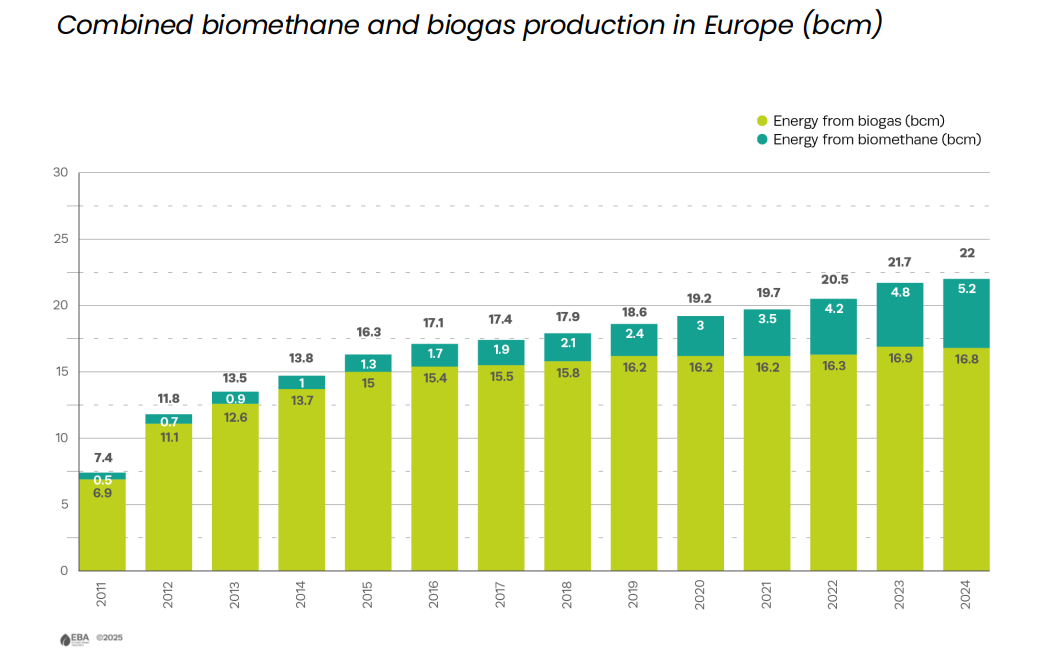
Current EU-27 production is equivalent to the entire inland gas demand of Belgium, Denmark, and Ireland together, 6% of the EU’s natural gas consumption. Biomethane continues to be the fastest-growing segment (5.2 bcm of which 4.3 produced in EU-27) supported by an installed capacity of 7 bcm/year in Europe by early 2025.
Biomethane plants in Europe
Europe closed 2024 with 1,620 biomethane-producing facilities, 111 more than in 2023. At least 86% of the plants are grid-connected. The number of countries producing biomethane has now reached 25, with Portugal joining in 2022, Lithuania and Ukraine in 2023, and Poland injecting its first biomethane into the grid in 2025. Ahead of 2030, €28.4 billion in private investment has already been committed to biomethane development in Europe.
The average size of a biomethane plant in Europe is 483 m3/h, almost four times the size of biogas plants producing electricity and heat.
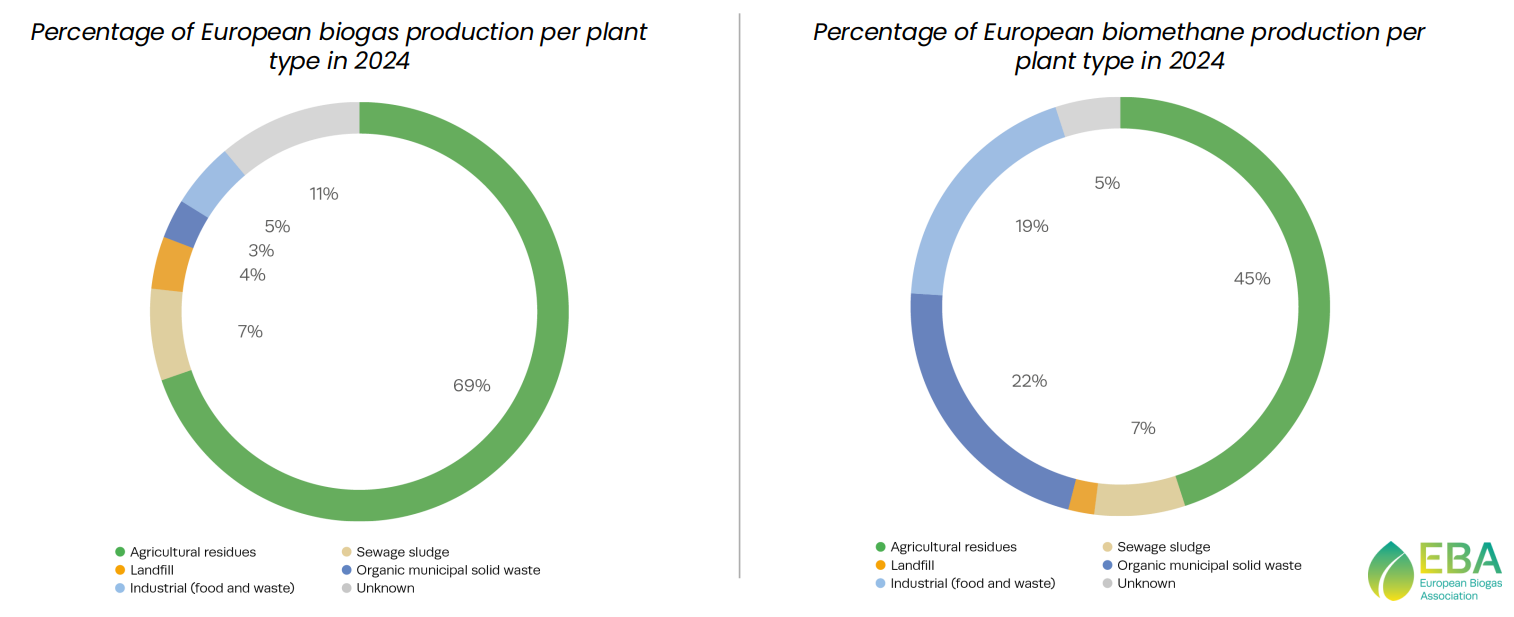
Production trends also show a continued shift towards sustainable feedstocks offering the highest greenhouse-gas savings, including agricultural residues, organic municipal solid waste, sewage sludge, and industrial by-products.
Production of liquefied biomethane
Currently, 16 European countries produce liquefied biomethane (bio-LNG): Belgium, Denmark, Finland, France, Germany, Italy, Latvia, the Netherlands, Norway, Poland, Portugal, Spain, Sweden, Switzerland, Ukraine and the United Kingdom. There are currently 101 bio-LNG production facilities operating in Europe.
By 2028, 153 additional bio-LNG production plants are expected to be built. This will increase production capacity by 13.1 TWh/year.
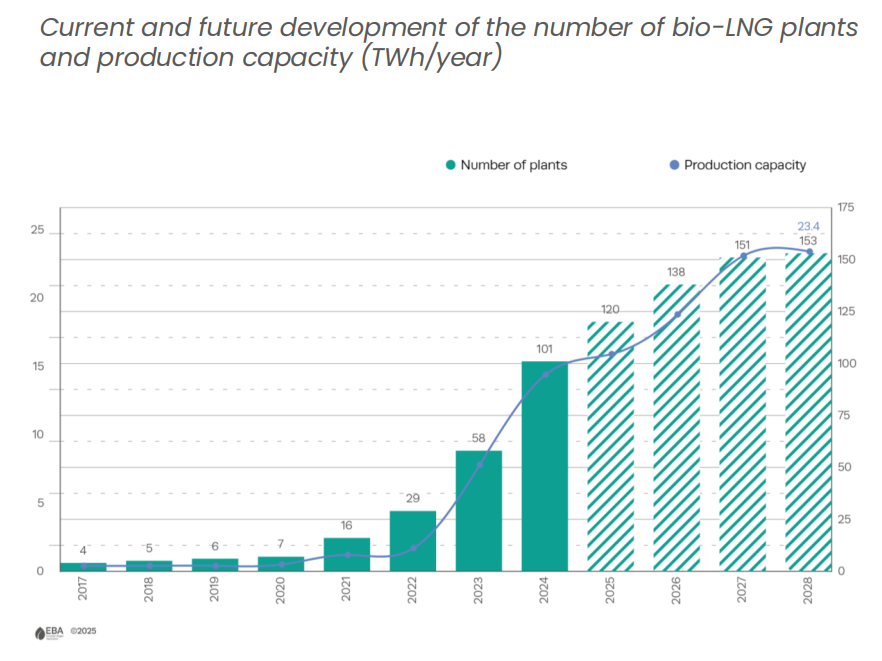
In addition, 80% of bio-LNG produced in Europe is used or planned to be used for road transport.
Digestate production
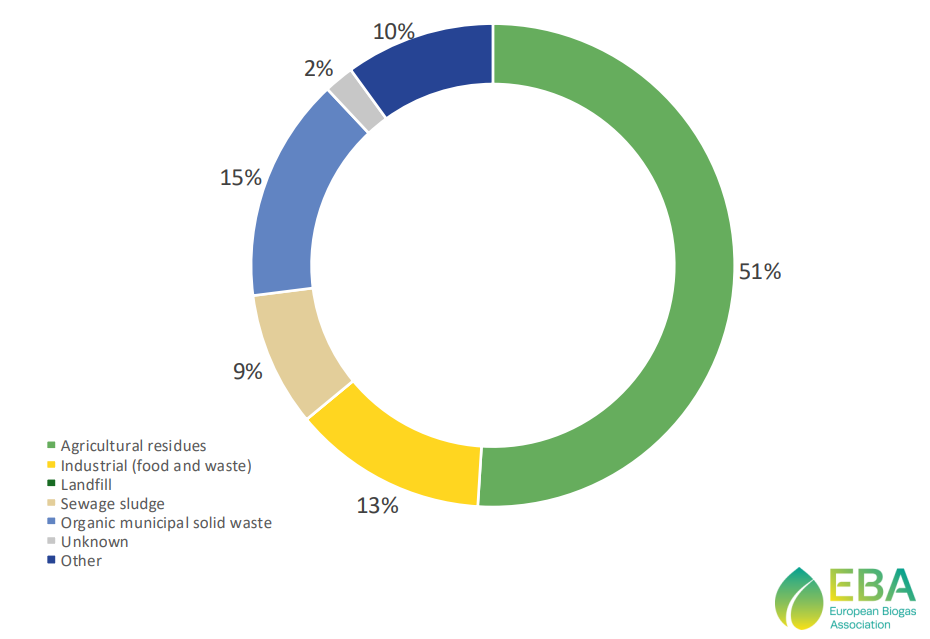
In 2024, 25 million tonnes (dry matter) of digestate were produced in Europe. Its established role as a soil improver and organic fertiliser is expanding, with new valorisation pathways gaining momentum. Digestate already has the potential to replace 17% of the EU’s nitrogen-based fertilisers. With projected sector growth, digestate could substitute over 65% of non-renewable nitrogen in the EU by 2040.
Biogas instead of imported fossil fuels
With EU-27 gas consumption at 332 bcm, and 273 bcm still imported, the report highlights the urgent need to scale domestic, renewable gas solutions. Biogases offer a direct pathway to reducing strategic energy dependence while increasing the competitiveness of Europe in its ambition to phase-out of fossil fuels.
At the same time, the EU’s dispatchable power generation capacity has fallen markedly, from 424 GW in 2012 to around 380 GW in 2023, despite the growing need for flexibility. As a clean, dispatchable energy source, biogases are essential for balancing the grid during extended periods of low solar and wind production.
Unlocking these resources will require stronger coordination between EU institutions and national governments to deliver coherent, predictable, and efficient policy frameworks. The potential for a Biogas Tripartite Agreement represents a critical opportunity to strengthen the coherence and predictability of policies at both European and national levels, key to restoring growth momentum and increasing demand for renewable gases.
The EBA Statistical Report offers the most comprehensive overview of the current status and future potential of Europe’s biogas and biomethane sectors. It covers EU-27 Member States as well as Iceland, Serbia, Switzerland, Norway, the UK, and Ukraine. The report features in-depth analysis of the European energy landscape, the diverse applications of biogases, digestate and bio-CO₂ production, and the sectors’ economic contribution to Europe.