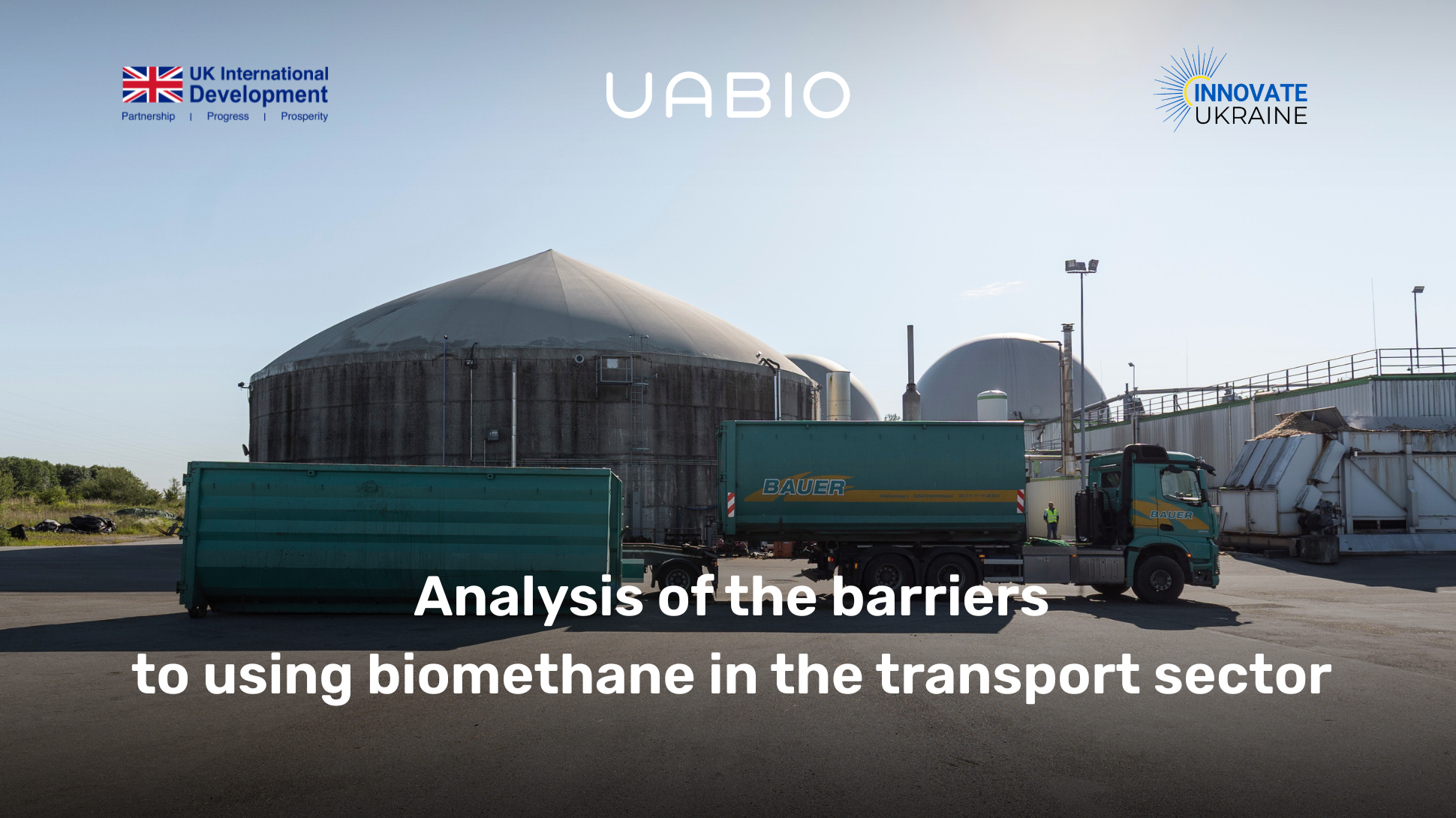
Analysis of the barriers to using biomethane in the transport sector — a report by UABIO
We are sharing the third important analytical document prepared as part of the Innovate Ukraine project: “Development of a Business Model for Biomethane Production in Ukraine”.
The issue of transport decarbonisation is extremely pressing, as transport plays a crucial role in the global economy by facilitating the movement of goods, people and services between different regions. Furthermore, this sector remains one of the largest consumers of fossil fuels (over 90 per cent), so its decarbonisation is a key prerequisite for achieving climate neutrality by 2050.
Biomethane is one of the most accessible alternatives for energy-intensive and long-distance transport. In this report, our experts have examined the potential, technical characteristics and regulatory framework for the use of this renewable gas as a motor fuel.
For use in transport, biomethane is compressed to 200 bar (Bio-CNG) or liquefied (Bio-LNG). Compressed biomethane is a fully-fledged substitute for natural gas. Liquefaction, on the other hand, is suitable for transporting biomethane over long distances where there is no access to gas networks (gas transmission or distribution systems) and for increasing the range per refuelling. Experience in the EU shows that the transition to these types of fuel does not require significant time or financial investment in the development of new infrastructure and technologies.
Download the report (in English)
Key topics of the report
- An overview of the biomethane market as a motor fuel and its use in the transport sector at European and global levels.
- European regulation, policy and support schemes in EU countries.
- Production and logistics of biomethane as a gaseous motor biofuel in the form of Bio-CNG and Bio-LNG.
- Road transport in Ukraine: fuel consumption statistics, vehicle fleet composition and the potential for biomethane consumption in the agricultural sector.
- Existing barriers and possible ways to overcome them.
Barriers to the use of biomethane in transport in Ukraine
Biomethane is a cost-effective solution for the decarbonisation of transport, enabling farmers to produce fuel from their own waste, cities to improve air quality, and meeting the needs of road, water and rail transport.
However, biomethane as a motor fuel faces a challenge right from the biomethane plant, as it is likely to have a higher production cost than natural gas. Furthermore, the infrastructure and processes involved in the production and retail sale of Bio-CNG and Bio-LNG require additional capital and operating costs. As a result, compressed natural gas will have a price advantage over Bio-CNG.
Key recommendations and conclusions for Ukraine
To overcome the regulatory and policy barriers hindering the growth of biomethane usage in the transport sector, it is crucial to adopt a long-term, strategic approach. One of the most effective ways to address this issue is by:
- Establishment of a domestic GHG emissions trading system that covers transport sector;
- Developing a Bioenergy/Biomethane Strategy and Roadmap till 2050;
- Development of basic law on biomethane use as motor fuel;
- State co-financing of the creation of filling station infrastructure to operate on bio-CNG and bio-LNG;
- Setting of biomethane consumption targets and targets for the number of the gas refuelling stations;
- Establishment of technical standards for biomethane in CNG and LNG applications;
- Amendments to the Tax Code regarding the reduction of customs duties and VAT on the import of equipment for the production and consumption of biomethane that is not produced in Ukraine.
The development of biomethane as a transport fuel in Ukraine presents a significant opportunity to reduce GHG emissions, enhance energy security, and support the transition toward a more sustainable energy sector. However, several regulatory and policy barriers must be addressed to unlock its full potential.
The general recommendations outlined in this report provide a basic framework for overcoming these challenges and fostering the growth of biomethane usage in transportation. By implementing these recommendations, Ukraine can establish a strong foundation for biomethane adoption in the transport sector.