BIOMAPE: The first newsletter of the project
Download the first international BIOMAPE project newsletter and learn more about accelerating the biomethane market and its implementation in Europe.
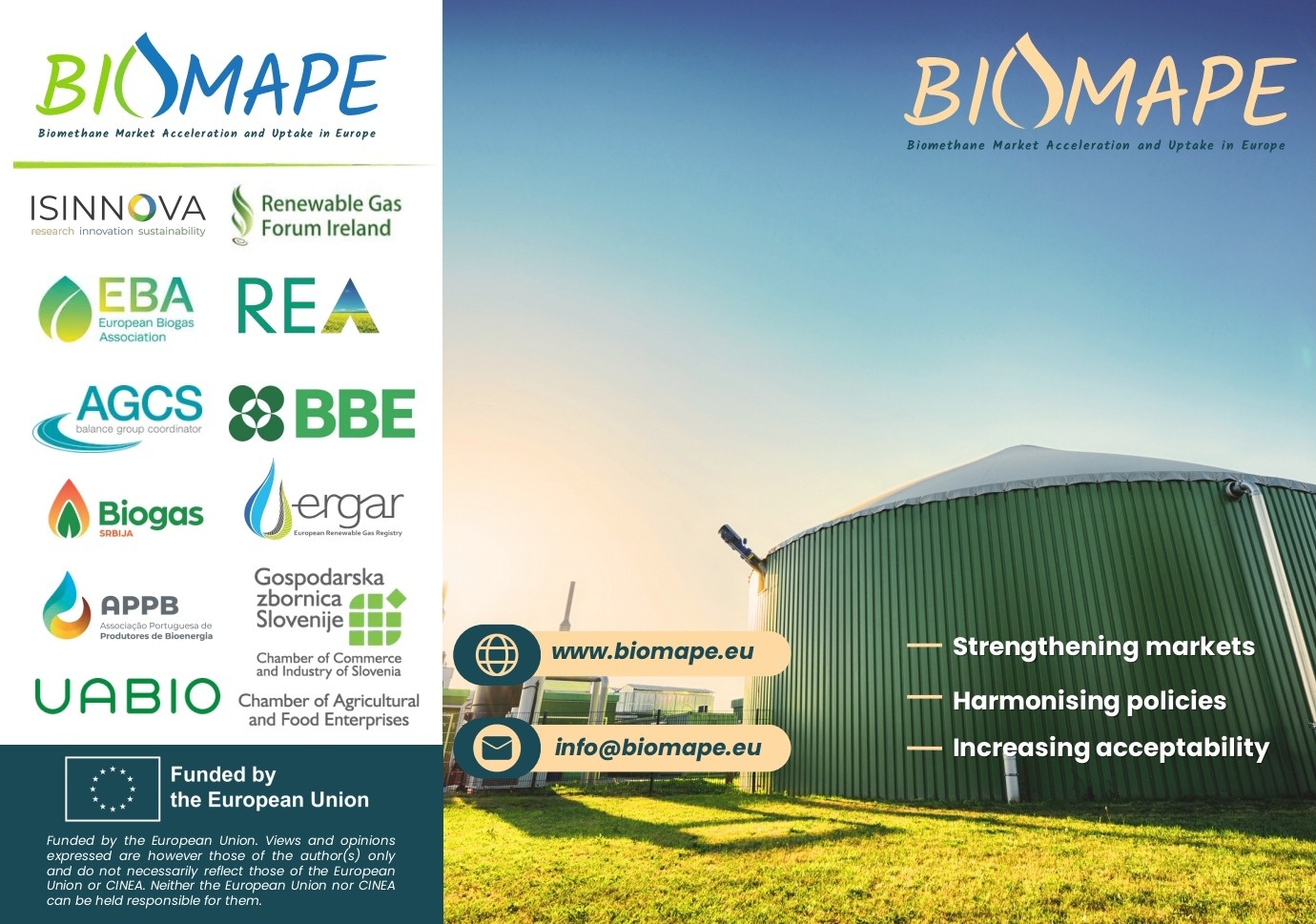
BIOMAPE (Biomethane Market Acceleration and Uptake in Europe) — a Horizon Europe project supporting the acceleration of biomethane production and use across Europe.
It helps establish robust market mechanisms, improves policy coherence, and strengthens public support through concrete measures such as creating registries, conducting thematic studies, and engaging stakeholders. BIOMAPE addresses some of the key barriers still limiting biomethane market growth in Europe.
Learn more about the project
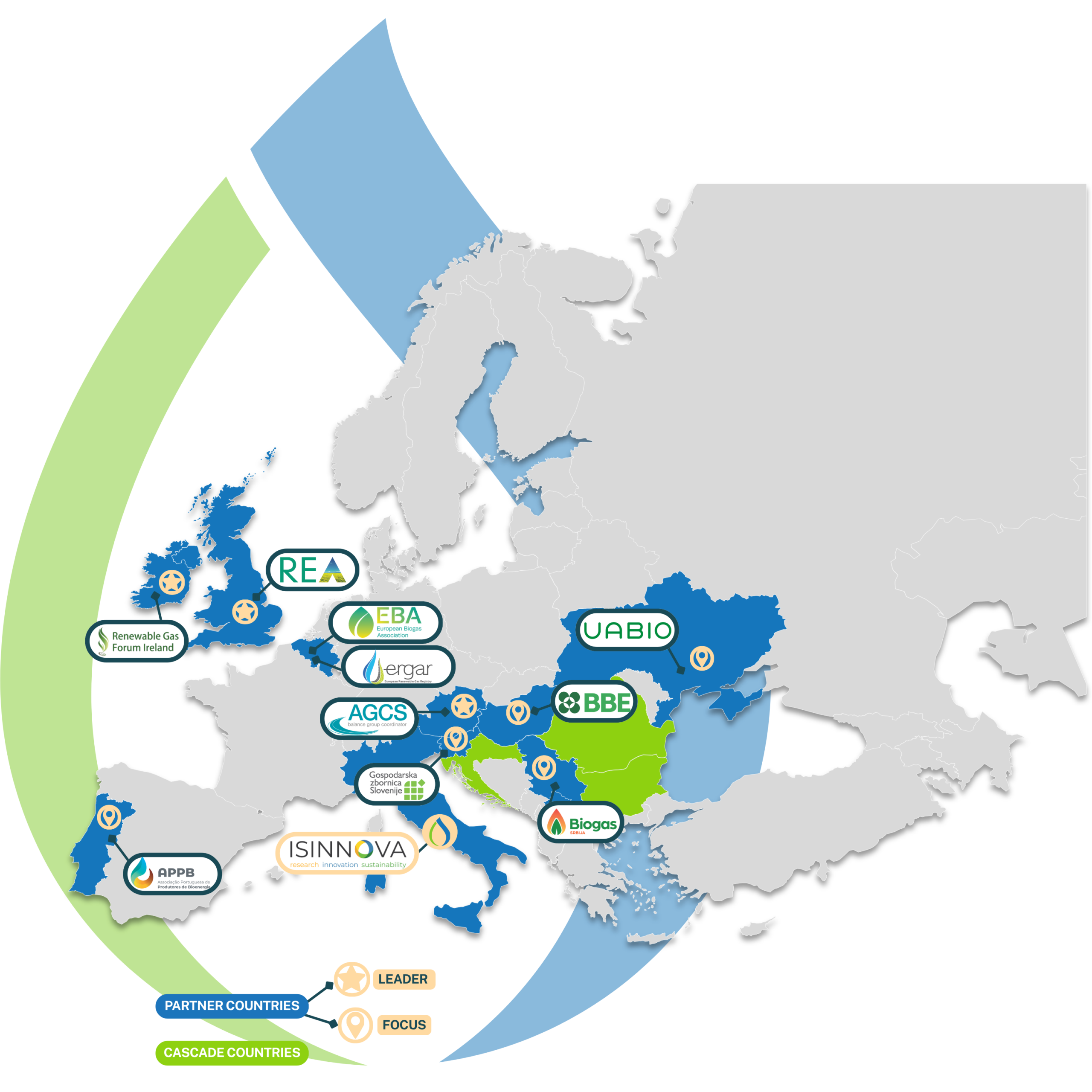
BIOMAPE will support the creation and strengthening of biomethane registries for certificate management in Hungary, Serbia, Slovenia, Portugal and Ukraine, while also facilitating more transparent and efficient cross-border trade. It will also work on policy development and social acceptability activities across eight European countries.
BIOMAPE is laying the groundwork for a transparent and sustainable biomethane market, while promoting cooperation and knowledge sharing in Europe and beyond. In total, the project brings together 11 partners from 10 countries, combining expertise in renewable gases, policy, market development, certification systems, research, and stakeholder engagement.
The first newsletter contains information about the BIOMAPE project and its main activities, as well as news from the biomethane sector in various European countries. It is available in several languages, including Ukrainian and English.
View in Ukrainian BIOMAPE Project International Newsletter No. 1 (May 2026)
View in English BIOMAPE Project International Newsletter No. 1 (May 2026)
Main points from the first newsletter
BIOMAPE has launched its Biomethane Support Policies Dashboard.
This living online resource designed to make biomethane policy information more accessible and easier to navigate. The dashboard supports BIOMAPE’s work on Biomethane Policy and Market Development, helping stakeholders explore the policy landscape shaping biomethane deployment across Europe. It will be further integrated and updated over the course of the project, as new information, insights and policy developments become available.
BIOMAPE’s updated guidelines for national registries.
The BIOMAPE project consortium is excited to announce significant progress on Deliverable 2.1, a comprehensive report providing updated guidelines for establishing national biomethane registries for certificate management across Europe. Building on earlier EU initiatives like BIOSURF and REGATRACE, this deliverable provides public authorities and market stakeholders with practical, actionable guidance.
New momentum for Hungary’s biomethane market.
In accordance with the RED II, the Hungarian Energy and Public Utility Regulatory Authority (MKEH) has been designated by a Government Decree as the official issuing body for Guarantees of Origin for renewable gases. A call for applications for investment subsidies was published on 23 September, 2025. The program was designed to support investments in biogas and biomethane production, the applications could be submitted from 28 October, 2025 onwards. According to estimates by the National Energy Agency (NEÜ), about 100 million EUR budget would allow for the support of 15-30 biogas/biomethane projects.
Biomethane development in Serbia — emerging opportunities, market progress and future perspectives.
The Serbian biogas sector has been steadily developing for more than a decade and a half and currently includes 45 operational biogas plants, while more than 55 additional projects are in the status of temporary privileged power producers. Although the sector has so far been primarily focused on electricity generation from biogas, increasing attention is now being directed toward biomethane as the next phase of sector development. At the moment, Serbia still does not have an operational biomethane plant, but interest in biomethane projects has significantly increased in recent years.
EBA and Guidehouse report on barriers to scaling up biomethane despite existing potential and geopolitical momentum.
The document confirms that Europe has ample resources to scale biomethane production but lacks the policy coherence needed to do so at pace. Currently, Europe produces around 22 billion cubic metres (bcm) of biogases, of which only 5 bcm is biomethane, far below its achievable potential. While the sector could reach approximately 34–35 bcm by 2030, this estimate has been revised downward due to delayed project deployment and insufficient policy action, not because of resource limitations.
The report underscores that biomethane could significantly reduce Europe’s reliance on imported fossil fuels. However, persistent regulatory uncertainty, fragmented support schemes, and slow implementation continue to hinder investment and project development. Without a stable and coherent policy framework, the sector risks falling short of its contribution to Europe’s climate and energy objectives.
Biomethane trade gains ground across Europe.
ERGaR, the European Renewable Gas Registry, closely follows EU-wide policy developments shaping the renewable gas market. At European level, new quotas, targets and sectoral obligations are increasingly influencing biomethane demand. One key demand driver in 2026 is the entry into force of FuelEU Maritime obligations for the shipping sector. As shipping companies are required to gradually reduce their greenhouse gas emissions, bio-LNG is emerging as an attractive solution, contributing to growing demand for biomethane across Europe.
At the same time, ERGaR is witnessing a clear increase in cross-border biomethane trade. In 2025, more than 4 TWh of biomethane were traded across borders through the ERGaR Certificate of Origin scheme, marking a record year for the organisation and confirming the growing role of biomethane in Europe’s renewable energy market.
Announcements
The second meeting of the BIOMAPE consortium and a technical workshop.
On May 27–28, 2026, in Ljubljana, the BIOMAPE partners will gather at the offices of their Slovenian partner, GZS — the Chamber of Commerce and Industry of Slovenia — to discuss the project’s progress during this initial phase and agree on the next steps.
Over the next three years, BIOMAPE will carry out coordinated activities structured around six interrelated work packages, each addressing a key aspect of biomethane development. Together, they integrate technical, policy, social, and market aspects into a unified framework that drives innovation and supports sustainable development across Europe.