Ukraine’s biomethane industry overview: achievements, potential and recommendations from the IEA
The International Energy Agency (IEA) has released an analytical report focusing on Ukraine’s biomethane potential and its significance for Europe’s energy security. In the publication, the Agency provides a detailed overview of the prospects and challenges facing our market.
The material clearly demonstrates how Ukraine can become a key supplier of “green” gas to the EU. The IEA provides clear regulatory and financial recommendations for the Ukrainian sector that will help attract investment, simplify grid connection, and remove export barriers.
Ukraine’s advantages in biomethane production
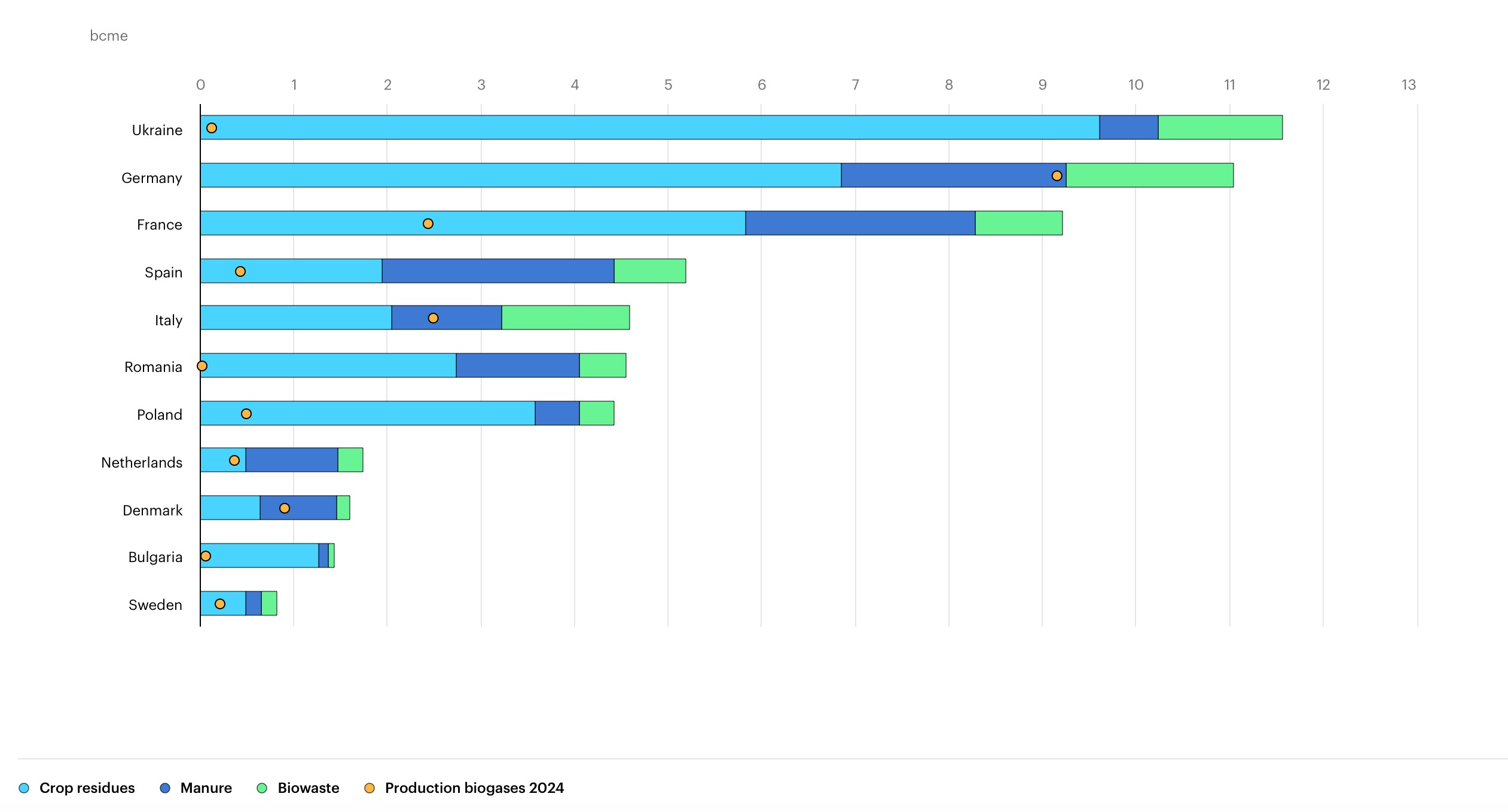
Ukraine’s 33 million hectares of agricultural land provide access to substantial feedstock volumes spanning agricultural waste and residues, cover crops, agro-industrial by-products and organic municipal solid waste. The IEA estimates Ukraine’s biogas and biomethane production potential, using only waste and residues, at roughly 11.6 billion cubic meters equivalent (bcme) per year, making it the European leader in terms of available feedstock.
Ukraine’s biomethane sector benefits from another advantage in addition to feedstock availability: well-developed domestic gas infrastructure. The country’s extensive gas network connects in the West and South to Poland, Hungary, Slovakia and Romania via Moldova, with a combined exit capacity of around 140 bcm of natural gas per year. Ukraine also hosts Europe’s largest underground gas storage facilities, with a total capacity of 31 bcm. Located mainly in the western part of the country, far from the frontline, these facilities could also be used to store biomethane alongside natural gas. Together, this infrastructure provides a strong foundation for scaling up biomethane production and unlocking new revenue streams as demand for renewable gases grows across Europe.
Recent key achievements in the sector
Ukraine’s biogas sector has expanded steadily since it began taking shape in 2015. By mid-2025, 85 plants with a combined installed electrical capacity of 140 MWe were in operation, including landfill gas facilities producing around 33 MWe. These numbers represent a biogas production in the range of 260-300 million cubic meter (mcm) per year. To date, most biogas production is used for electricity and heat generation.
At the same time, the biomethane market is taking shape. Ukraine’s first biomethane plant fed gas into the national grid in 2023, and by February 2025, Ukraine had reached a milestone by making its first biomethane export to the EU. In addition, in the fall of 2025, the first shipment of liquefied biomethane (bio-LNG) was transported by road from Ukraine to Germany.
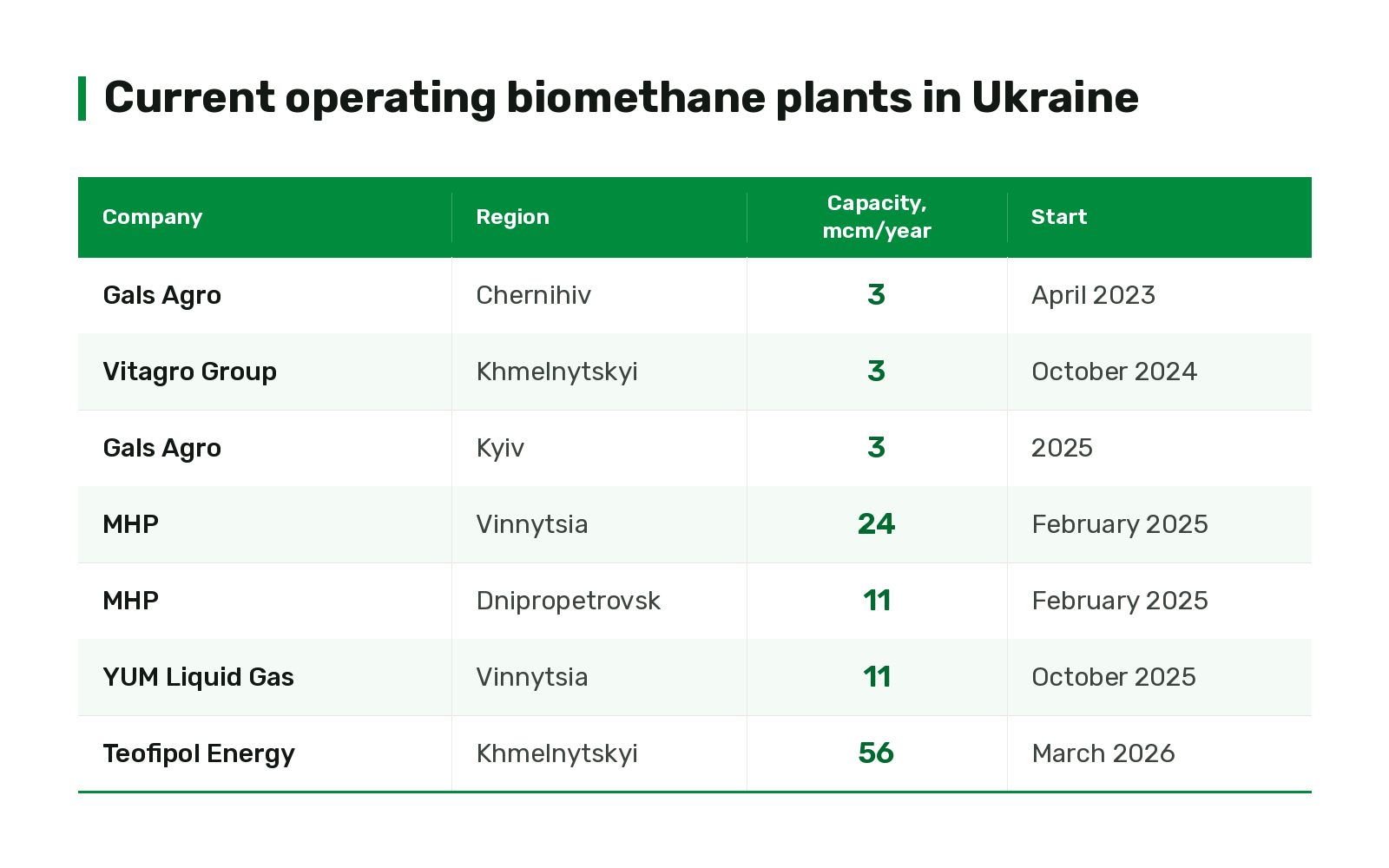
As of March 2026, seven biomethane plants were operating in Ukraine with an installed capacity of 111 mcm/year, equivalent to around 0.5% of Ukraine’s gas consumption. While still small relative to national gas demand, Ukraine’s current production scale is comparable to the early commercial stage of biomethane development in countries such as Denmark, where biomethane output remained below 0.2 bcm/year before accelerating rapidly in the 2010s, to around 1bcm today. In addition, five new plants with total installed capacity of 20 mcm/year are expected to become operational in 2026 in Ukraine, further scaling production capacity and signalling a shift from pilot deployment towards early market expansion.
Renewable gases as a factor in sustainability, flexibility, and safety
Biomethane directly strengthens Ukraine’s energy security by reducing dependence on gas imports. This is particularly critical following the Russian attacks in 2025, which temporarily shut down about 60% of production. Thanks to its decentralized structure, biomethane production is less vulnerable to large-scale attacks, which enhances the resilience of the energy system during wartime and contributes to its long-term transformation.
In addition, biomethane accelerates European integration: it helps reduce emissions in transportation and heavy industry (particularly in metallurgy), enabling Ukrainian exporters to meet the requirements of the European CBAM mechanism. The industry’s development also stimulates the agricultural sector, creates jobs, expands the market for organic fertilizers (digestate), and supports the domestic machinery manufacturing industry, as approximately 50% of the equipment for these plants is manufactured in Ukraine.
The strategic importance of renewable gases in Europe is growing
The EU has identified biomethane as a key element of its strategy: the REPowerEU plan calls for an increase in its production to 35 billion cubic meters by 2030. However, according to IEA projections, production will reach only about 26 billion cubic meters, and the resulting shortfall underscores the need for external suppliers (which is also enshrined in the 2026 AccelerateEU package).
Strong EU demand – particularly in markets such as Germany – creates attractive price signals for Ukrainian producers. Ukrainian biomethane production is estimated to be profitable at EUR 800-900 per thousand cubic meter (tcm), against its production costs of about EUR 650/tcm and domestic natural gas prices of around EUR 382/tcm prior to the onset of the Middle East conflict. In contrast, some EU biomethane markets offer up to EUR 1 000/tcm, making exports particularly attractive.
National goals and key barriers to scaling up
Ukraine’s biomethane production deployment programme, approved in April 2026, sets ambitious production targets of 1 bcm of biomethane per year by 2030 and 2.1 bcm per year by 2035, building on the previous production target in its National Energy and Climate Plan (NECP) and National Renewable Energy Action Plan (2024).
The NECP also includes projections for heating and cooling output from biogas, electricity generation from both biogas and biomethane, and biomethane use in transport. Altogether, these projections correspond to the equivalent of an additional 2 bcme of biogas by 2030, on top of the 1 bcme biomethane target. While biomethane is expected to expand more rapidly, biogas, a lower-cost fuel that can be consumed directly on site, will continue to represent a significant share of the country’s renewable gases supply.
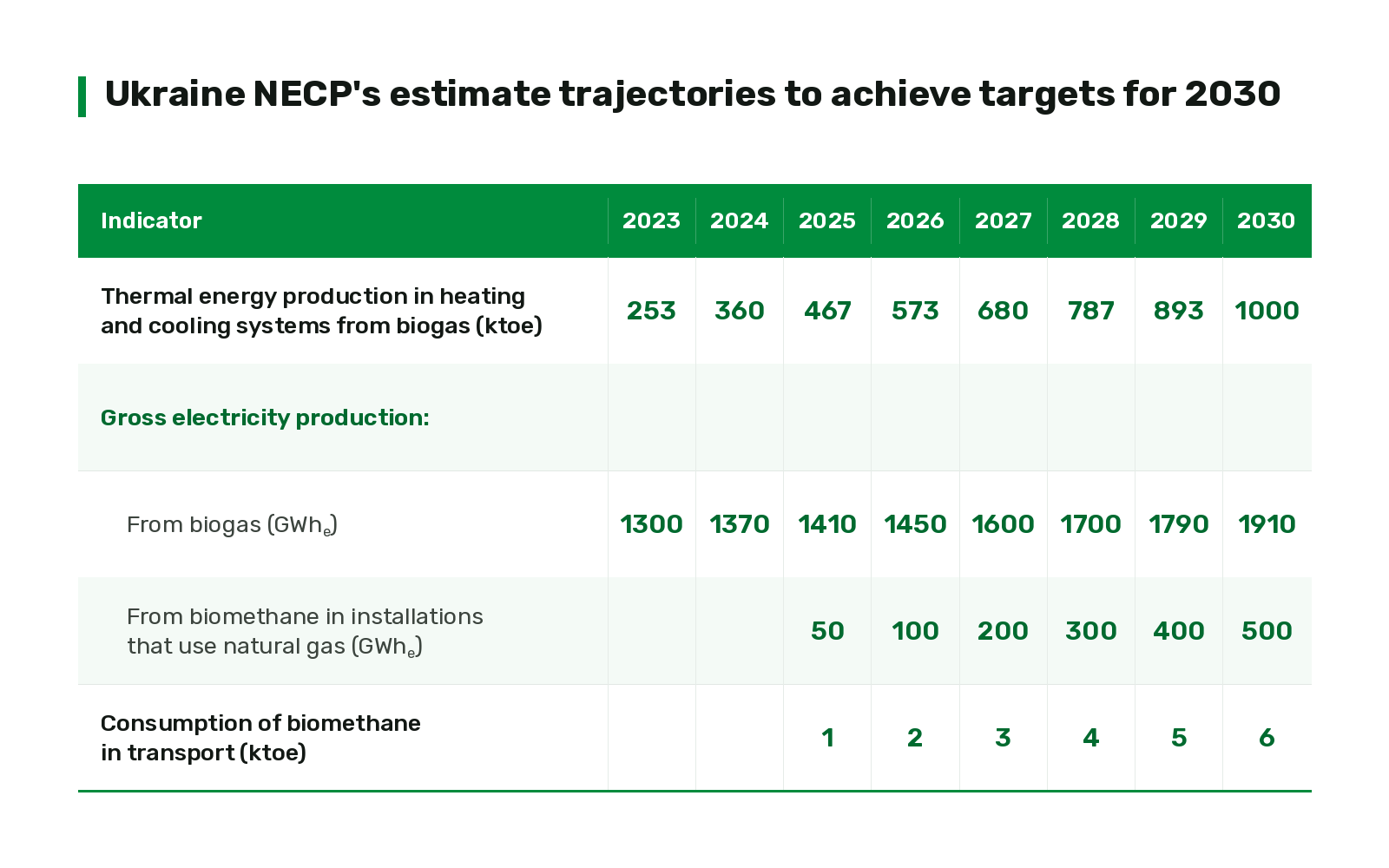
However, several challenges continue to constrain sector growth. Currently, biomethane struggles to compete in a highly subsidised natural gas market, where households and district heating companies pay only around one third of market prices. Support mechanisms that reflect the environmental benefits of biomethane also remain weak. For instance, Ukraine’s CO2 tax is very low – around UAH 30/t CO2 or EUR 0.6/t CO2 – and biomethane is still subject to fossil CO2 taxation, despite being a biogenic fuel, unlike in countries such as Sweden, Germany and the United Kingdom.
Infrastructure and technical constraints add further challenges, including the need to upgrade and adapt existing gas network infrastructure, ensure compliance with gas quality standards, and coordinate with system operators for grid integration. In addition, war-related risks continue to weigh on investor confidence, concerning both national and international investors.
Progress in the regulatory sphere
Ukraine’s experience with renewable electricity offers a useful reference point. Support mechanisms under the Alternative Energy Sources Act, combined with competitive auctions, have helped drive the deployment of biogas-based power generation. A similar stable and transparent policy framework for biomethane could accelerate investment, reduce risks and support further integration with European energy markets.
Access to EU export markets is particularly important for generating demand signals and attracting investment, and Ukraine has taken concrete steps to enable this. These include permitting biomethane exports and a range of project incentives in place since 2023 for biogas and biomethane projects above EUR 12 million, covering tax exemptions, import duty waivers on new equipment, preferential land use rights and compensation for grid connection costs.
A further milestone was the launch of a national biomethane registry in February 2026, aligned with EU sustainability, certification and tracking requirements, following a Ukraine-EU Memorandum of Understanding signed in 2023. The registry enables certificates to be issued, transferred and cancelled, preventing double counting and laying the groundwork for future interoperability with the EU Union Database. More recently, the approval of a Programme for the Development of Biomethane Production by 2035, together with its accompanying Action Plan, marks an important step in establishing short- and medium-term production targets backed by institutional coordination and a clear implementation strategy.
Recommendations for scaling up Ukraine’s biomethane sector
Ukraine can unlock its biomethane potential through a clear and stable policy framework that lowers investment risks, builds domestic demand, and supports integration with European markets. Key priorities include:
- Ensure implementation of a clear long-term strategy and governance framework. Building on the adopted Ukraine Biomethane Development Program 2035, ensure effective implementation through clear governance and coordination, while extending the strategy with post-2035 targets aligned with European Union climate goals.
- Deploy targeted financial support and de-risk investment. Explore the introduction of incentives to production – such as feed-in premiums or contracts for difference -, capital grants, concessional finance and risk-sharing tools, while continuing to mobilise international funding.
- Enable infrastructure integration and EU market access. Simplify permitting and grid connection, upgrade gas networks, continuing to align sustainability standards with the EU, and remove remaining export barriers.